If you spend time on Snapchat, you’ve probably received a message that simply says “WYA?”. For many people, especially those new to social media slang, those three letters can be confusing at first glance.
The abbreviation appears in chats, snaps, stories, and even other platforms like Instagram, TikTok, and text messages. Since online communication moves quickly, people often shorten common phrases into a few letters to save time and keep conversations flowing naturally.
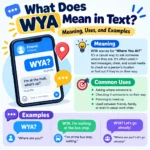
So, what does WYA mean in Snapchat? In most cases, it stands for “Where You At?” It’s a casual way of asking someone where they are or what they’re currently doing.
Understanding this simple expression can help you avoid misunderstandings and communicate more confidently in online conversations.
WYA – Quick Meaning
WYA = Where You At?
People use it to ask about someone’s location, availability, or current activity.
Common meanings:
- Where are you right now?
- What are you doing?
- Are you available to chat or meet?
- What’s your current situation?
Examples
“WYA? We’re all waiting for you.”
“Hey, WYA? Haven’t heard from you today.”
“WYA tonight? Want to hang out?”
The exact meaning depends on the context and the relationship between the people involved.
Origin & Background
WYA originated from everyday spoken English, particularly the phrase “Where you at?” which has been used in casual conversation for decades.
As texting became more popular in the early 2000s, users started shortening longer phrases into abbreviations. Mobile phones often had limited keyboards, making shorter messages more convenient.
Social media accelerated the trend. Platforms such as Snapchat, Instagram, TikTok, and messaging apps encouraged fast communication. Abbreviations like WYA became part of digital culture because they were easy to type and instantly recognizable.
Over time, the meaning expanded beyond physical location. Someone might send WYA not because they need an address but because they want attention, conversation, or reassurance that a friend is available.
Today, WYA remains one of the most widely used texting abbreviations among teenagers and adults alike.
Real-Life Conversations
WhatsApp Conversation
Andrew:
Hey man, WYA?
David:
Still at the gym.
Andrew:
We’re ordering food soon.
David:
Give me 20 minutes and I’ll be there.
Instagram DM
Sophia:
WYA? Haven’t seen you post anything today.
Emma:
Just relaxing at home.
Sophia:
Good. I thought you disappeared.
TikTok Comments
Jason:
WYA when this song drops live?
Mark:
Front row if I can get tickets.
Jason:
Same here.
Text Message
Olivia:
WYA? The movie starts in ten minutes.
Ryan:
Parking the car now.
Olivia:
Perfect. Hurry in.
Emotional & Psychological Meaning
Although WYA looks like a simple location question, it often carries emotional meaning.
People use it when they:
- Want to connect
- Miss someone
- Need reassurance
- Feel curious
- Want attention
- Are planning something together
In many friendships, receiving a WYA message feels warm and personal. It signals that someone is thinking about you.
Imagine a close friend who usually texts every day. One evening, you don’t hear from them. Hours later, a simple “WYA?” arrives. The message is technically asking about your location, yet it also communicates interest and concern.
This emotional layer explains why WYA remains popular across many social platforms.
Usage in Different Contexts
Social Media
On Snapchat, Instagram, and TikTok, WYA often starts conversations.
Examples:
- WYA today?
- WYA this weekend?
- WYA at the party?
Friends & Relationships
Friends commonly use WYA when making plans.
In romantic relationships, it may express affection or curiosity.
Examples:
- WYA babe?
- WYA tonight?
- WYA? Miss talking to you.
Work or Professional Settings
Professional environments usually favor complete sentences.
Instead of WYA, consider:
- Where are you currently?
- Are you available?
- Could you provide an update?
Using WYA at work can appear overly casual depending on the workplace culture.
Casual vs Serious Tone
Casual:
“WYA? Come join us.”
More Serious:
“WYA? Everyone is worried about you.”
Context determines whether the tone feels playful, urgent, or caring.
When NOT to Use It
There are situations where WYA may not be the best choice.
Formal Communication
Avoid using it in:
- Job applications
- Business emails
- Academic correspondence
- Official documents
Sensitive Situations
If someone is experiencing a difficult situation, a direct abbreviation may seem impersonal.
Cultural Differences
Not everyone understands internet slang. Some people may interpret it differently or find it confusing.
High-Stakes Conversations
When clarity matters, writing a full question is usually better.
For example:
“Where are you right now?” provides more precision than “WYA?”
Common Misunderstandings
Several misunderstandings occur with WYA.
Assuming It Always Means Location
Many people think WYA only asks for a physical location.
Sometimes it means:
- What are you doing?
- Are you free?
- Why haven’t you replied?
Misreading the Tone
The phrase can sound:
- Friendly
- Flirtatious
- Curious
- Concerned
The relationship between sender and receiver affects interpretation.
Taking It Too Literally
A friend asking WYA may simply want conversation rather than a specific address.
Comparison Table
| Expression | Meaning | Similarity to WYA |
|---|---|---|
| WYA | Where You At? | Original phrase |
| WYD | What You Doing? | Focuses on activity |
| HBU | How About You? | Continues conversation |
| BRB | Be Right Back | Indicates temporary absence |
| LMK | Let Me Know | Requests information |
| IDK | I Don’t Know | Expresses uncertainty |
| CU | See You | Future interaction |
| OMW | On My Way | Response to location questions |
Key Insight
WYA is unique because it often combines location, availability, and social connection into a single short message. Few abbreviations communicate all three ideas so efficiently.
Variations / Types
1. WYA RN
Where You At Right Now — asks for immediate location.
2. WYA Tonight
Used when making evening plans.
3. WYA Bro
Friendly version between close friends.
4. WYA Fam
Informal version used within a social group.
5. WYA ASAP
Requests a quick response.
6. WYA Though
Adds curiosity or mild surprise.
7. WYA Lately
Asks about someone’s recent activities.
8. WYA These Days
Focuses on life updates rather than location.
9. WYA Online
Checks whether someone is active digitally.
10. WYA Everyone
Used in group chats to gather participants.
How to Respond When Someone Uses It
Casual Replies
- At home.
- Just got back from work.
- Hanging out with friends.
- On the way.
Funny Replies
- Lost in another dimension.
- Hiding from responsibilities.
- Somewhere with snacks.
- Living my best life.
Mature Replies
- I’m currently busy but will reply later.
- Working at the moment. What’s up?
- Home with family. Everything okay?
Respectful Replies
- I’m available now. How can I help?
- Currently occupied, but I’ll respond soon.
- Thanks for checking in. I’m doing well.
Regional & Cultural Usage
Western Culture
WYA is widely used among teenagers and young adults. It often serves as a quick social check-in.
Asian Culture
Many users understand WYA through global social media trends. English abbreviations are common in online messaging, especially among younger generations.
Middle Eastern Culture
The abbreviation appears frequently among bilingual users who combine English slang with local languages in digital conversations.
Global Internet Usage
The internet has transformed WYA into a nearly universal abbreviation. Users across different countries recognize it even if English is not their first language.
Generational Differences
Gen Z
- Uses WYA frequently.
- Often combines it with emojis and other slang.
- Treats it as a natural conversation starter.
Millennials
- Understand it easily.
- May use it less often than younger users.
- Sometimes prefer complete sentences.
Is It Safe for Kids?
Yes, WYA is generally considered safe.
The phrase itself is harmless and simply means “Where You At?”
Parents should still encourage children to be careful when sharing real-time locations online. The abbreviation is not problematic, but revealing personal location information to strangers can create privacy concerns.
Context always matters more than the slang itself.
FAQs
What does WYA mean on Snapchat?
WYA usually means “Where You At?” It asks about someone’s location, activity, or availability.
Is WYA flirting?
Sometimes. The phrase can be flirtatious when used between people with romantic interest, though it is often completely friendly.
What should I reply to WYA?
You can share your location, describe what you’re doing, or ask what the other person needs.
Is WYA rude?
No. It’s generally considered casual and friendly.
Do adults use WYA?
Yes. While popular among younger users, adults frequently use it in text messages and social media chats.
What’s the difference between WYA and WYD?
WYA asks where someone is, while WYD asks what someone is doing.
Can WYA mean something other than location?
Yes. It can also imply “What’s going on with you?” or “Why haven’t you been around lately?”
Conclusion
WYA is one of the simplest yet most versatile abbreviations used on Snapchat and across social media. While its primary meaning is “Where You At?”, the phrase often carries deeper social and emotional significance. It can express curiosity, friendship, concern, excitement, or a desire to connect.
The key to understanding WYA is context. A message from a close friend may feel different from one sent by a classmate, coworker, or romantic interest. Once you recognize the tone behind the abbreviation, responding becomes easy and natural.
As online communication continues to evolve, WYA remains a useful expression that helps people stay connected quickly and casually. Knowing how and when to use it allows you to participate confidently in modern digital conversations.