If you’ve ever received a message that simply says “WYA?”, you may have paused for a second before replying. It looks short, informal, and direct, but its meaning depends on the conversation. From casual chats with friends to quick check-ins between family members, this abbreviation has become a common part of digital communication.
People search for WYA means in text because they want to understand whether it’s friendly, romantic, urgent, or simply asking for someone’s location. Since texting relies on short messages instead of facial expressions or voice tone, even a simple abbreviation can create uncertainty.
This guide explains exactly what WYA means, where it came from, how people use it today, and when you should—or shouldn’t—use it.
WYA Means in Text – Quick Meaning
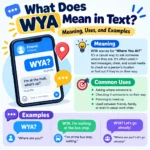
WYA stands for “Where You At?”
It is an informal way of asking where someone is or what they’re currently doing. While the literal meaning asks for a person’s location, it often carries a social purpose, such as checking in or inviting someone to join an activity.
Quick facts:
- Full form: Where You At?
- Tone: Casual and friendly
- Used in: Text messages, Snapchat, Instagram, WhatsApp, TikTok, Messenger, and other social platforms
- Best used with: Friends, family, classmates, or people you know well
Examples
“WYA? Everyone’s waiting for you.”
“Hey, WYA? We just got here.”
“WYA tonight? Want to hang out?”
Origin & Background
The phrase “Where you at?” has existed in spoken English for decades, especially in conversational American English. Before smartphones became popular, people simply asked this question during phone calls.
As texting evolved, users naturally shortened long phrases to save time. Instead of typing “Where are you?” or “Where you at?”, people began using WYA.
The abbreviation became especially popular with younger internet users through SMS texting, online gaming, and social media. Platforms like Snapchat, Instagram, TikTok, and Discord helped spread the expression worldwide.
Today, WYA isn’t limited to asking someone’s physical location. It can also mean:
- Why haven’t you replied?
- Are you coming?
- What’s your plan?
- Are you available?
Its meaning depends entirely on the conversation.
Real-Life Conversations
Andrew:
WYA? We’re ordering food.
David:
Five minutes away. Don’t order without me!
Instagram DMs
Sophia:
WYA? I haven’t seen your stories today.
Emma:
I’ve been studying all afternoon.
TikTok Comments
Liam:
WYA? We need Part 2!
Creator:
Uploading it tonight!
Text Messages
Mia:
WYA after work?
Noah:
Heading home now. Want to grab coffee?
Emotional & Psychological Meaning
Although WYA literally asks about someone’s location, it often communicates something more meaningful.
Someone who sends WYA may be expressing:
- Curiosity
- Excitement
- Concern
- Affection
- Anticipation
- A desire to reconnect
Digital conversations often remove emotional signals like facial expressions. Because of that, simple abbreviations help people stay connected without writing lengthy messages.
For example, imagine a close friend who hasn’t replied all day. Instead of sending a long paragraph, you simply text:
“WYA?”
That single message communicates interest, care, and a desire to continue the conversation without overwhelming the other person.
Usage in Different Contexts
Social Media
WYA frequently appears in Snapchat chats, Instagram DMs, TikTok comments, and Facebook Messenger.
Examples include:
- WYA tonight?
- WYA? Join the live!
- WYA everyone?
Friends and Relationships
Friends often use WYA when making plans or checking on each other.
Examples:
- WYA? Movie starts in twenty minutes.
- WYA? We miss you.
Romantic partners may also use it as a playful way to start a conversation.
Work or Professional Settings
WYA is generally too informal for professional communication.
Instead, write:
- Where are you currently?
- Are you available?
- Have you arrived?
- Could you share your location?
Professional messages benefit from complete sentences and a respectful tone.
Casual vs Serious Tone
In casual conversations, WYA sounds friendly and relaxed.
In urgent situations, however, it can sound more demanding depending on punctuation.
Compare these examples:
- WYA 😊
- WYA?
- WYA NOW!
The tone changes significantly even though the words stay the same.
When NOT to Use It
Avoid using WYA in situations where professionalism or clarity matters.
Examples include:
- Business emails
- Job interviews
- Academic assignments
- Formal customer communication
- Conversations with people unfamiliar with texting slang
It may also confuse older users or people who are still learning English.
When clarity matters more than speed, write the complete question instead.
Common Misunderstandings
Many people assume WYA always asks for a physical location.
In reality, it can also mean:
- Are you coming?
- Why aren’t you responding?
- Are you free?
- What’s happening?
Another misunderstanding involves tone.
Some people interpret WYA as impatient, while others see it as friendly. The surrounding conversation usually explains the intended meaning.
Understanding context prevents unnecessary confusion.
Comparison Table
| Expression | Meaning | Typical Use |
|---|---|---|
| WYA | Where You At? | Asking someone’s location or availability |
| WYD | What You Doing? | Asking about current activity |
| BRB | Be Right Back | Temporary absence |
| LMK | Let Me Know | Request for information |
| HBU | How About You? | Continuing a conversation |
| ETA | Estimated Time of Arrival | Asking arrival time |
| OMW | On My Way | Traveling toward someone |
| AFK | Away From Keyboard | Temporarily unavailable |
Key Insight
Although these abbreviations often appear together, WYA focuses primarily on someone’s location or availability rather than their activity or future plans.
Variations and Related Expressions
1. WYD
Asks what someone is doing right now.
2. WSP
Means “What’s up?” and starts a casual conversation.
3. HMU
Invites someone to contact you later.
4. OMW
Lets others know you’re traveling toward them.
5. ETA
Requests or gives an expected arrival time.
6. LMK
Asks someone to provide information later.
7. HBU
Keeps a conversation going by asking the other person’s opinion.
8. Sup
A shortened version of “What’s up?”
9. RU There?
Checks whether someone is available.
10. Ping Me
Requests someone to send a message when they’re free.
How to Respond When Someone Uses It
Casual Replies
- At home.
- Almost there.
- Just arrived.
- On my way.
Funny Replies
- Lost in the snack aisle.
- Somewhere with good Wi-Fi.
- Secret mission.
- Hiding from responsibilities.
Mature Replies
- I’m finishing work right now.
- I’ll be there in fifteen minutes.
- I’m busy at the moment but I’ll message you later.
Respectful Replies
- I’m currently unavailable.
- Thanks for checking in.
- I’ll let you know when I arrive.
Regional & Cultural Usage
Western Culture
WYA is widely used among teenagers and young adults. It feels natural in everyday texting.
Asian Culture
Many English-speaking internet users understand WYA, although local messaging habits may favor complete sentences in formal conversations.
Middle Eastern Culture
The abbreviation appears mainly among younger bilingual users who regularly communicate in English online.
Global Internet Usage
Gaming communities, social media platforms, and international friendships have made WYA recognizable across many countries.
Gen Z vs Millennials
Gen Z uses WYA naturally in fast-paced conversations.
Millennials understand it well but may alternate between abbreviations and complete sentences depending on the situation.
Is It Safe for Kids?
Yes. WYA is generally considered a harmless texting abbreviation.
Parents should simply teach children to be cautious when sharing their real-time location with strangers online. The abbreviation itself is safe, but privacy awareness remains important.
FAQs
What does WYA mean in text?
It means “Where You At?”, an informal way of asking where someone is or whether they’re available.
Is WYA rude?
No. It usually sounds friendly. Tone depends on the relationship and context.
Is WYA flirting?
Sometimes. Romantic partners may use it playfully, although friends use it just as often.
Can I use WYA at work?
It’s better to avoid it in professional communication. Write the complete question instead.
Is WYA the same as WYD?
No. WYA asks about location or availability, while WYD asks what someone is doing.
Does WYA only refer to location?
Not always. It can also ask whether someone is available, coming, or responding.
Why is WYA so popular?
It’s quick, easy to type, and instantly understood by many social media users.
Conclusion
Understanding WYA means in text helps you communicate more naturally in today’s digital conversations. Although it literally asks “Where You At?”, the expression often carries a friendlier purpose, whether someone is checking in, making plans, or simply keeping a conversation going.
The key is reading the surrounding context. A simple three-letter abbreviation can express curiosity, excitement, concern, or affection depending on who sends it and why. Once you recognize how WYA is commonly used, you’ll feel more confident replying to it and using it yourself in casual conversations.