
If you spend time texting, scrolling through social media, or chatting in online communities, you’ve probably seen someone send a simple message: “WYA?”
At first glance, it can look confusing, especially for people who are unfamiliar with modern internet slang. Some assume it is an abbreviation for a company, a game term, or even a typing mistake. In reality, it is one of the most common texting shortcuts used today.
People search for the meaning of WYA because they want to understand messages correctly and avoid awkward misunderstandings. Knowing how and when to use it can help you communicate more naturally in digital conversations.
This guide explains the meaning, origins, emotional context, examples, cultural usage, and everything else you need to know about WYA.
WYA – Quick Meaning
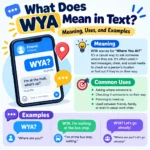
WYA stands for:
“Where You At?”
It is an informal way of asking someone where they are or what they are currently doing.
Common uses include:
- Asking someone’s location
- Checking if someone is available
- Starting a conversation
- Seeing why someone has not replied
Examples:
“WYA? We’re waiting for you.”
“Hey, WYA right now?”
“Haven’t heard from you all day. WYA?”
The phrase is casual and mainly used among friends, family members, classmates, and people who know each other well.
Origin & Background
WYA developed from spoken English, particularly the phrase “Where are you at?” which became shortened in text messaging.
During the early SMS era, people often abbreviated common phrases to save time and character space. Short forms such as LOL, BRB, and WYA became popular because they were quick to type.
The rise of smartphones accelerated its use. Messaging apps made fast communication the norm, and users increasingly preferred short expressions over complete sentences.
Social media platforms also played a major role. WYA appeared frequently on:
- Snapchat
- TikTok
- Facebook Messenger
Over time, its meaning expanded. Instead of asking only for a physical location, WYA sometimes became a way of asking:
- What are you doing?
- Why haven’t you responded?
- Are you available?
- Are you coming?
This flexibility helped make it a staple of modern online communication.
Real-Life Conversations
WhatsApp Conversation
Andrew:
Hey, everyone is already here.
David:
Give me ten minutes.
Andrew:
WYA?
David:
Stuck in traffic near the mall.
Instagram DM Conversation
Sophia:
You disappeared after posting that story.
Emma:
Haha, I know.
Sophia:
WYA though?
Emma:
At my cousin’s birthday dinner.
TikTok Comment Section
Jason:
You said the live stream was starting.
Mia:
Technical issues.
Jason:
WYA? We’ve been waiting.
Mia:
Going live in five minutes.
Text Message Conversation
Michael:
Movie starts at 8.
Ryan:
I know.
Michael:
WYA?
Ryan:
Parking the car now.
These examples show how naturally WYA fits into everyday conversations.
Emotional & Psychological Meaning
Although WYA literally asks for someone’s location, it often carries additional emotional meaning.
Depending on the situation, it may express:
- Curiosity
- Concern
- Excitement
- Anticipation
- Affection
- Frustration
A close friend texting “WYA?” may simply miss talking to you.
A partner sending “WYA?” could be checking in because they are thinking about you.
Someone waiting for you at an event might use it because they are eager for you to arrive.
I have often seen friends use WYA when a group gathering is about to start. The message usually isn’t about location alone. It reflects excitement and a desire to include everyone in the moment.
This emotional layer is one reason the abbreviation remains popular.
Usage in Different Contexts
Social Media
WYA frequently appears in:
- Comments
- Direct messages
- Stories
- Group chats
It helps users reconnect quickly without writing lengthy messages.
Friends and Relationships
Among friends, WYA is often friendly and relaxed.
Examples:
- “WYA tonight?”
- “WYA? Come join us.”
In relationships, it may indicate interest, attention, or affection.
Work and Professional Settings
Professional communication generally requires more formal language.
Instead of WYA, consider:
- “Where are you currently located?”
- “Have you arrived yet?”
- “Are you available for the meeting?”
Using WYA at work may appear overly casual unless you have a very informal relationship with colleagues.
Casual vs Serious Tone
The tone depends heavily on context.
Casual:
“WYA? We’re getting pizza.”
Serious:
“WYA? We’ve been trying to reach you.”
The same abbreviation can feel completely different depending on the circumstances.
When NOT to Use It
There are situations where WYA may not be appropriate.
Professional Communication
Avoid using it in:
- Job applications
- Business emails
- Formal meetings
Sensitive Situations
Someone experiencing a difficult moment may interpret repeated WYA messages as pressure.
Communication With Strangers
People who do not know you well may find it intrusive.
Formal Educational Settings
Teachers, professors, and administrators usually expect complete sentences rather than internet slang.
Common Misunderstandings
Many people misunderstand WYA because of its flexible usage.
Assuming It Always Means Location
Sometimes it means:
- What are you doing?
- Why are you absent?
- Are you available?
Reading It as Aggressive
The phrase itself is neutral.
The surrounding conversation determines whether it sounds friendly, impatient, or concerned.
Confusing It With Other Slang
Many texting abbreviations look similar, creating confusion for newer users.
Understanding context is usually the key.
Comparison Table
| Expression | Meaning | Tone | Usage |
|---|---|---|---|
| WYA | Where you at? | Casual | Asking location or availability |
| WYD | What you doing? | Casual | Asking about activity |
| BRB | Be right back | Informative | Temporary absence |
| HBU | How about you? | Friendly | Continuing conversation |
| IMO | In my opinion | Conversational | Sharing views |
| AFK | Away from keyboard | Informative | Not currently active |
| Here | Present and available | Direct | Opposite response |
| Missing out | Not present | Informal | Opposite situation |
Key Insight
WYA is unique because it combines location, availability, and social connection into a single short expression. Its meaning depends more on context than many other internet abbreviations.
Variations / Types
1. WYA RN
Meaning: Where are you right now?
Used when someone needs an immediate answer.
2. WYA Bro
Meaning: Asking a male friend where he is.
Adds a friendly tone.
3. WYA Sis
Meaning: Asking a female friend where she is.
Common in close friendships.
4. WYA Tonight
Meaning: Asking about evening plans.
Often used for social events.
5. WYA At
Meaning: Extended version of WYA.
Popular in texting and spoken language.
6. WYA Tho
Meaning: Where are you though?
Adds emphasis.
7. WYA Fam
Meaning: Asking a close friend or group member.
Creates a sense of belonging.
8. WYA ASAP
Meaning: Requesting a quick response.
Shows urgency.
9. WYA Everyone
Meaning: Directed toward a group.
Common in group chats.
10. WYA Today
Meaning: Asking about someone’s location or plans for the day.
Frequently used among friends.
How to Respond When Someone Uses It
Casual Replies
- “Just got home.”
- “At the gym.”
- “Heading out now.”
- “With friends.”
Funny Replies
- “Somewhere on planet Earth.”
- “Hidden from responsibilities.”
- “Searching for snacks.”
- “In my secret headquarters.”
Mature Replies
- “I’m running late but on my way.”
- “Currently at work. I’ll reply later.”
- “I’m busy right now, but everything is fine.”
Respectful Replies
- “Thank you for checking in. I’m at home.”
- “I’m safe and doing well.”
- “Sorry for the delay. I’m available now.”
Regional & Cultural Usage
Western Culture
WYA is extremely common among younger users in the United States, Canada, and the United Kingdom.
It often serves as a quick conversation starter.
Asian Culture
Many young social media users understand WYA through exposure to English-language content.
Usage is generally concentrated among digitally active audiences.
Middle Eastern Culture
The abbreviation appears frequently in multilingual online conversations, especially among younger generations who communicate in English.
Global Internet Usage
Gaming communities, social networks, and messaging platforms have helped spread WYA worldwide.
Many users recognize it even when English is not their first language.
Generational Differences
Gen Z
- Uses WYA frequently
- Comfortable with abbreviations
- Often combines it with emojis and slang
Millennials
- Generally understand WYA
- May alternate between abbreviations and full sentences
Older generations often prefer complete phrases over shortened forms.
Is It Safe for Kids?
Yes, WYA is generally safe for kids.
The abbreviation itself is harmless and simply asks where someone is or what they are doing.
Parents should still teach children not to share precise locations with strangers online. Context matters more than the phrase itself.
FAQs
What does WYA mean in texting?
WYA means “Where You At?” It is an informal way to ask where someone is or what they are doing.
Is WYA rude?
No. It is usually friendly and casual. Tone depends on the situation.
Can WYA mean more than location?
Yes. It can also ask about availability, plans, or a lack of response.
Is WYA popular on social media?
Yes. It is widely used on Instagram, TikTok, Snapchat, WhatsApp, and other messaging platforms.
Should I use WYA in business emails?
No. Professional communication typically requires more formal wording.
How do I reply to WYA?
Simply share your location, activity, or availability depending on the context.
Is WYA used by Gen Z?
Yes. It remains one of the most common abbreviations among Gen Z users.
Conclusion
WYA is a simple abbreviation with a surprisingly broad role in modern communication. While it literally means “Where You At?”, its purpose often goes beyond location. It can express curiosity, connection, concern, anticipation, or a desire to continue a conversation.
Understanding the context behind WYA makes digital communication easier and more natural. Whether you encounter it in a text message, a WhatsApp group, an Instagram DM, or a TikTok comment, you’ll know exactly what the sender is trying to communicate.
The next time someone sends “WYA?”, you can respond confidently, knowing the meaning behind those three letters and the social connection they often represent.