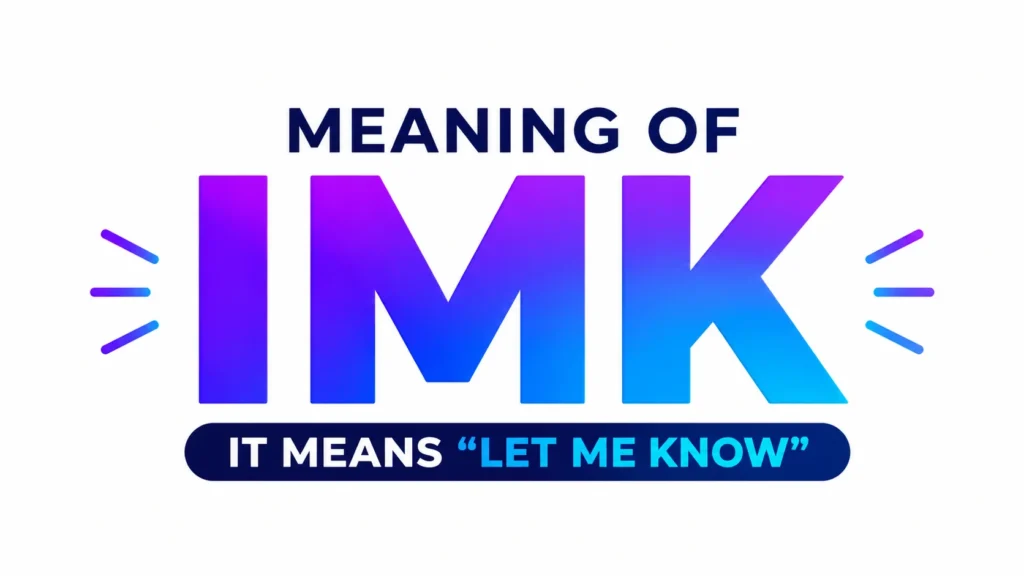
Online conversations move quickly, and abbreviations help people communicate without typing long messages. One acronym that often creates confusion is IMK. If you have received it in a text, seen it in a social media comment, or noticed it in a direct message, you may have wondered what the sender actually meant.
The meaning of IMK can vary slightly depending on the conversation, but in most cases, it stands for “In My Knowledge.” People use it when sharing information they believe to be true based on what they know.
Many users search for this term because it is less common than abbreviations such as LOL, BRB, or IMO. Its meaning is not always obvious, especially for people who are new to internet slang or messaging culture.
Understanding IMK helps prevent misunderstandings and makes online communication feel much more natural.
IMK – Quick Meaning
IMK = In My Knowledge
It is used to express information, opinions, or facts based on what someone currently knows.
Simple Definition
- Means “as far as I know”
- Shows uncertainty or limited knowledge
- Softens statements to avoid sounding overly confident
- Common in texting and social media conversations
Examples
“IMK, the store closes at 8 PM.”
“IMK, they haven’t announced the results yet.”
“IMK, that feature is only available on premium accounts.”
In each example, the speaker is sharing information without claiming absolute certainty.
Origin & Background
Unlike some internet abbreviations that originated from early chatrooms, IMK emerged more gradually through texting culture and social media communication.
As messaging became faster, people looked for shorter ways to express common phrases. “As far as I know” appeared frequently in conversations, creating a need for a compact alternative.
The abbreviation gained visibility on platforms where quick responses matter:
- Text messaging
- Instagram DMs
- TikTok comments
- Snapchat chats
- Online forums
Its popularity increased because it helps users communicate information while leaving room for correction if new facts emerge later.
This style reflects a broader shift in digital communication. Modern users often prefer language that sounds flexible and conversational rather than absolute.
Real-Life Conversations
WhatsApp Conversation
Andrew:
Do you know if the meeting starts at 10?
David:
IMK, it’s scheduled for 10:30.
Andrew:
Perfect, thanks for checking.
Instagram DM
Sophia:
Is that restaurant still open?
Emma:
IMK, yes. My friend went there last week.
Sophia:
Great, I’ll give it a try.
TikTok Comments
Ryan:
Did they release a new episode today?
Mia:
IMK, it comes out tomorrow.
Ryan:
Good to know.
Text Message
Jacob:
Is Sarah coming to the party?
Liam:
IMK, she’s still deciding.
Jacob:
Hopefully she makes it.
These examples show how naturally IMK fits into everyday conversations.
Emotional & Psychological Meaning
Language is about more than information. It also communicates attitude and emotion.
When someone uses IMK, they often signal humility. They are sharing knowledge while acknowledging that they may not have every detail.
This creates a more cooperative tone.
Instead of saying:
“That is definitely true.”
A person might write:
“IMK, that’s true.”
The second version feels more approachable and less confrontational.
In many online spaces, people appreciate this style because it reduces arguments and encourages open discussion.
I once saw a group discussion where several people were debating an event schedule. One participant used IMK before sharing information. Others responded positively because the wording sounded helpful rather than authoritative. A simple abbreviation changed the entire tone of the conversation.
Usage in Different Contexts
Social Media
IMK appears frequently in comments and replies.
People use it when discussing news, trends, entertainment, or community topics.
Example:
“IMK, that update hasn’t been released yet.”
Friends & Relationships
Friends often use IMK when answering questions casually.
Example:
“IMK, he’s still on vacation.”
The tone feels relaxed and friendly.
Work & Professional Settings
IMK occasionally appears in workplace chats.
Example:
“IMK, the report should be finished by Friday.”
Even so, many professionals prefer writing the full phrase in formal communication.
Casual vs Serious Tone
Casual:
“IMK, they’re already there.”
More Serious:
“As far as I know, the investigation is ongoing.”
The audience often determines whether the abbreviation is appropriate.
When NOT to Use It
There are situations where IMK may not be the best choice.
Formal Business Emails
Many recipients may not recognize the abbreviation.
Academic Writing
Universities and educational institutions generally expect complete wording.
Legal Documents
Precision matters, making abbreviations inappropriate.
Sensitive Discussions
Topics involving health, safety, or major decisions require clear communication.
Using IMK in those situations may create uncertainty.
Common Misunderstandings
Several misconceptions surround IMK.
Assuming It Means Certainty
Some readers interpret it as a factual statement.
In reality, it usually indicates limited knowledge.
Confusing It With Other Acronyms
People sometimes mistake IMK for:
- IMO (In My Opinion)
- IMHO (In My Humble Opinion)
- IDK (I Don’t Know)
Each abbreviation serves a different purpose.
Ignoring Context
The surrounding conversation often determines the intended meaning.
Without context, interpretations can vary.
Comparison Table
| Expression | Meaning | Tone | Usage |
|---|---|---|---|
| IMK | In My Knowledge | Informative | Sharing known information |
| IMO | In My Opinion | Personal | Giving opinions |
| IMHO | In My Humble Opinion | Polite | Offering viewpoints |
| IDK | I Don’t Know | Uncertain | Expressing lack of knowledge |
| FYI | For Your Information | Informative | Sharing updates |
| Factually | Based on verified facts | Certain | Confirmed information |
Key Insight
IMK occupies a unique position between confidence and uncertainty. It allows people to contribute information while acknowledging that their knowledge may not be complete.
Variations and Related Types
1. IMO
In My Opinion.
Used when expressing personal beliefs.
2. IMHO
In My Humble Opinion.
Adds politeness to an opinion.
3. IDK
I Don’t Know.
Signals uncertainty.
4. AFAIK
As Far As I Know.
Very close in meaning to IMK.
5. FYI
For Your Information.
Shares useful information.
6. TBH
To Be Honest.
Introduces honest thoughts.
7. TBF
To Be Fair.
Adds balance to a discussion.
8. ICYMI
In Case You Missed It.
Highlights information someone may have overlooked.
9. FWIW
For What It’s Worth.
Offers perspective without pressure.
10. NGL
Not Gonna Lie.
Introduces a candid statement.
How to Respond When Someone Uses It
Casual Replies
- “Got it.”
- “Thanks for letting me know.”
- “That makes sense.”
Funny Replies
- “Looks like you’re my information source today.”
- “I’ll trust your knowledge for now.”
- “You’ve earned temporary expert status.”
Mature Replies
- “Thanks for sharing what you know.”
- “I’ll verify it and get back to you.”
- “That helps clarify things.”
Respectful Replies
- “I appreciate the information.”
- “Thank you for explaining.”
- “That’s useful context.”
Regional & Cultural Usage
Western Culture
IMK is generally understood as an informal texting abbreviation.
Younger users recognize it more quickly than older audiences.
Asian Culture
English-based abbreviations are increasingly common among bilingual internet users.
Recognition varies by country and platform.
Middle Eastern Culture
Usage exists mainly within English-speaking online communities.
The term is less common in everyday offline communication.
Global Internet Usage
Social media has helped abbreviations spread across borders.
People often learn them through exposure rather than formal instruction.
Gen Z vs Millennials
Gen Z:
More likely to use abbreviations naturally in daily conversations.
Millennials:
Usually recognize the term but may choose full phrases more often.
Is It Safe for Kids?
Yes.
IMK is generally considered a harmless abbreviation.
It does not contain offensive language and is commonly used to share information or opinions.
Parents should still encourage children to understand context because internet slang can sometimes have multiple meanings depending on the conversation.
Frequently Asked Questions
What does IMK stand for?
IMK usually stands for “In My Knowledge.”
Is IMK the same as IMO?
No. IMK refers to knowledge, while IMO refers to personal opinion.
Is IMK rude?
Not at all. It is generally polite and conversational.
Can IMK be used at work?
It can be used in informal workplace chats, though full wording is often better for professional communication.
Is IMK popular on social media?
Yes. It appears on messaging apps, comments, and direct messages.
Does IMK mean someone is unsure?
Often yes. It suggests the person is sharing information based on what they currently know.
Should I use IMK in formal writing?
No. Formal writing usually requires complete phrases rather than abbreviations.
Conclusion
The meaning of IMK is simple once you understand the context. Most commonly, it stands for “In My Knowledge” and helps people share information without sounding overly certain. That balance makes it useful in modern digital communication.
Whether you encounter it in a text message, an Instagram conversation, or a TikTok comment, IMK usually signals that someone is providing information based on what they currently know.
Understanding abbreviations like IMK can make online interactions smoother and less confusing. The next time you see it, you’ll know exactly what the sender is trying to communicate and can respond with confidence.